Discover the powerful German-English online translator with ArabicLib – the perfect assistant for smooth, accurate, and context-aware translations. Designed for both beginners and professionals, our intuitive interface offers over 100 languages and thousands of language pairs, ensuring broad usability for all your translation needs.
German and English are both Germanic languages, sharing many linguistic roots. However, there are notable differences and unique translation challenges between the two:
ArabicLib's platform offers an advanced German-English dictionary containing hundreds of thousands of entries. Each word features clear definitions, accurate pronunciation guides, example sentences, synonyms, and even audio support. Whether you are a language learner or a professional translator, these resources help you understand the full context behind every translation.
Reinforce your knowledge with ArabicLib’s interactive tests: select the correct translation and track your progress in real time. Use the flashcard system to memorize essential words and phrases effectively. Explore the phrasebook and lexicon sections, pre-filled with basic and useful expressions for travel, everyday conversation, and professional use.
Experience the new standard in German-English online translation and language learning with ArabicLib – powerful, reliable, and designed with your needs in mind.
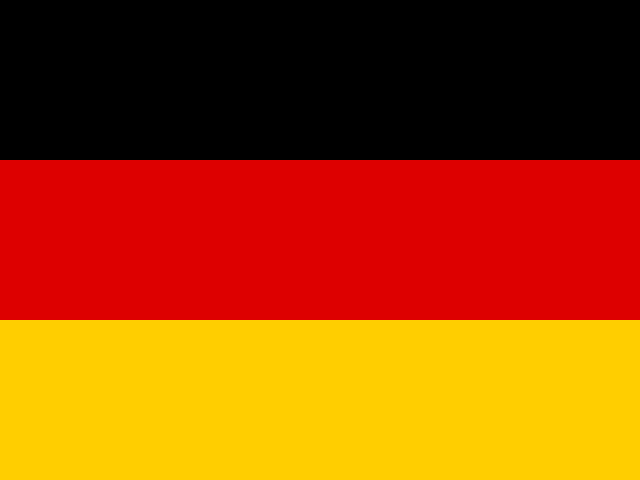
German is a beautiful and complex language spoken by over 100 million people around the world. It is the official language of Germany, Austria, and parts of Switzerland, as well as being a minority language in several other countries.
One of the most interesting aspects of German is its intricate grammar system, which features several cases, genders, and verb conjugations. This can make the language challenging to learn for non-native speakers, but also adds depth and nuance to the language that allows for more precise expression of thoughts and ideas.
German also has a rich literary and cultural heritage, with famous authors such as Johann Wolfgang von Goethe and Thomas Mann, and contributions to music, art, and philosophy. The language has a unique ability to convey complex and abstract concepts with its compound words, which are formed by combining two or more words to create a new, single word with a specific meaning.
Another interesting aspect of German is its many dialects and regional variations. From the Low German spoken in the northern regions of Germany, to the Swiss German spoken in Switzerland, each dialect has its own unique features and nuances.
In recent years, German has become an increasingly important language in the world of business and technology, particularly in Europe. As one of the most widely spoken languages in the European Union, knowledge of German can be a valuable asset for those looking to work or study in the region.
Overall, German is a fascinating and diverse language that offers a window into the rich cultural heritage and modern-day innovations of Germany and other German-speaking countries. Whether you're interested in literature, music, philosophy, or simply want to expand your linguistic horizons, German is a language that is well worth exploring.

English is a fascinating language with a rich history and vibrant culture. It is one of the most widely spoken languages in the world, with over 1.5 billion speakers worldwide, making it an essential tool for communication and understanding across international borders.
One of the most interesting things about English is its evolution. The language has evolved over time from Old English, which was spoken by the Anglo-Saxons in England during the medieval period. Over time, it transformed into Middle English, before finally becoming the Modern English that we know today.
Today, English is the official language of over 50 countries, including the United States, Canada, Australia, and the United Kingdom. It is also used as a lingua franca, meaning it is often used as a common language between people who speak different native languages.
English has many dialects and variations, each with its own unique features and nuances. Some of the most widely spoken dialects include American English, British English, and Australian English. Despite these differences, all varieties of English share a standard written form known as Standard English.
Additionally, English has a rich literary tradition, with notable works of poetry and prose written by famous writers such as William Shakespeare, Jane Austen, and Ernest Hemingway. English is also the primary language of instruction in many academic settings around the world, making it an important tool for pursuing higher education and research.
Learning English can be a challenging but rewarding experience. English grammar rules can be complex, and mastering pronunciation can be difficult. However, with practice and dedication, anyone can become fluent in the language and enjoy all the benefits it has to offer.
Lastly, English has become an essential tool for those interested in exploring global culture and engaging in international business and diplomacy. Mastery of the language can open up many opportunities for personal and professional growth, allowing individuals to connect with people from all over the world and gain a deeper understanding of diverse cultures.
In conclusion, English is a fascinating and endlessly useful language that deserves to be studied and appreciated. Its rich history, diverse dialects, literary tradition, and global importance make it an endlessly interesting language to learn and master. Learning English is a valuable skill that can open up many opportunities for personal and professional growth, as well as provide a gateway to understanding the diverse cultural traditions of English-speaking countries around the world.
| Diese Dinge gehören nur mir. | These things belong only to me. |
| Wer ist dein Lieblingsblogger? | Who is your favorite blogger? |
| Die Hoffnung bleibt noch. | Hope still remains. |
| Die Straße biegt hier rechts ab. | The road turns right here. |
| Wie viel zahlen sie dir? | How much do they pay you? |
| Ich habe auf ihn gezählt. | I counted on him. |
| Wann und wo kann man sie sehen? | When and where can you see her? |
| Der Rock ist in der Taille weit. | The skirt is wide at the waist. |
| Dein Wunsch ist mein Befehl. | Your desire is my command. |
| Ich werde es niemandem erzählen. | I will never tell anyone. |
| Ich wollte, dass du mich siehst. | I wanted you to see me. |
| Ist Tom allein da? | Is Tom there alone? |
| Er riet mir, nicht zu rauchen. | He advised me not to smoke. |
| Das wollte ich dir sagen. | I wanted to tell you this. |
| Ich will Tom finden. | I want to find Tom. |
| Ich werde direkt sein. | I will be direct. |
| Ich werde Hilfe brauchen. | I will need help. |
| Liest du ein interessantes Buch? | Are you reading an interesting book? |
| Das ist eine Silbermünze. | This is a silver coin. |
| Ich werde Geld brauchen. | I will need money. |
| Wo sind die Autoschlüssel? | Where are the car keys? |
| Er ist nicht viel älter als ich. | He is not much older than me. |
| Willkommen zurück. | Welcome back. |
| Sprechen Sie Mazedonisch? | Do you speak Macedonian? |
| Niemand hat sie unterstützt. | Nobody supported her. |
| Sie sind vom Aussterben bedroht. | They are in danger of extinction. |
| Ich weiß, wie alt du bist. | I know how old you are. |
| Ich denke, Sie wissen davon. | I think you know about it. |
| Lass sie alle kommen. | Let them all come. |
| Meine Meinung ist deiner ähnlich. | My opinion is similar to yours. |