ArabicLib's English-Czech Online Translator is a powerful, intuitive tool designed for seamless translation between English and Czech. Leveraging a robust engine that supports over 100 languages and thousands of unique pairs, ArabicLib stands out as a leading solution for instant, high-quality translations, including English-Czech. The clean interface features two windows for quick translation and editing, providing users with a smooth and efficient translation experience. Whether you’re a beginner or an advanced user, ArabicLib provides tools, resources, and guidance to enhance your interaction with English and Czech languages.
English and Czech represent distinct branches within the Indo-European language family—English is a Germanic language, while Czech is a Slavic language. Here are some key similarities and differences:
Translating between English and Czech often requires careful attention to context, especially for word order, case, and the use of articles. Idiomatic expressions may not always have direct equivalents. The translation process is further complicated by Czech's system of formal vs. informal address ("vy" vs. "ty"), which must be selected based on social context.
ArabicLib is more than just a translator. The English-Czech dictionary contains hundreds of thousands of word entries, giving users access not only to single-word translations, but also definitions, synonyms, antonyms, example sentences, and detailed pronunciation guides. Each entry is curated for both learners and professionals, supporting precise and context-aware learning.
Interactive tests, including flashcard games for all supported language pairs, allow learners to challenge their vocabulary, strengthen memory, and monitor progress. For practical communication, the Phrasebook section offers ready-to-use expressions, while the Vocabulary modules provide themed word lists for various situations and levels.
Experience effective, accurate, and user-friendly English-Czech translation with ArabicLib—your trusted companion for language learning and cross-cultural communication.

The English language is one of the most widely spoken languages in the world, with over 1.5 billion speakers worldwide. It is the official language of many countries, including the United States, United Kingdom, Canada, Australia, and New Zealand. English is also one of the most diverse languages, with numerous dialects and accents that can vary greatly from region to region.
The history of the English language is fascinating, as it has evolved and borrowed from many other languages over time. Its roots can be traced back to the Germanic tribes of the 5th century, but it was heavily influenced by the Latin language during the Middle Ages, and later by French during the Norman Conquest of England in 1066. English continued to evolve with the Renaissance and the Age of Exploration, and today it continues to adapt to new technologies and global influences.
One of the most interesting aspects of English is its vast vocabulary, which includes over 170,000 words. This is due in part to the language's ability to borrow from other languages, resulting in a rich and diverse lexicon. Additionally, English has a complex grammar system, with many irregular verbs and exceptions to the rules.
English is also a language of opportunity, as it is widely used in business, education, and technology. Many people around the world learn English as a second language in order to improve their chances of success in these areas. In fact, English is often referred to as the "language of international communication" due to its widespread use in diplomacy, trade, and academia.
Despite its complexity, the English language is incredibly versatile and expressive. It has produced some of the greatest literature in history, including the works of Shakespeare, Austen, and Dickens, and continues to inspire new writers and poets today. Whether you're reading a classic novel or chatting with a friend, the English language offers endless possibilities for communication and creativity.
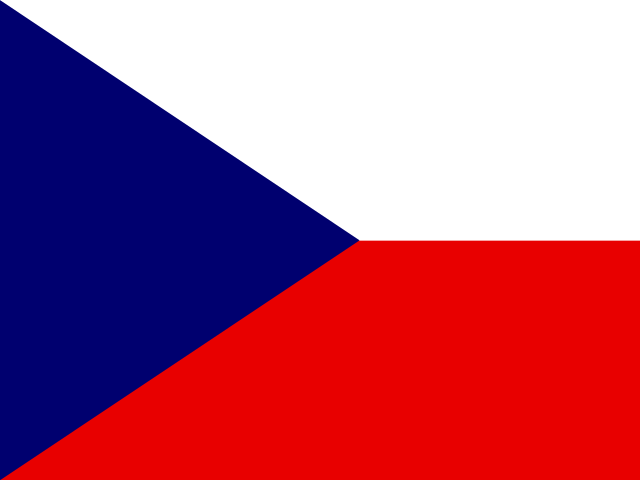
Czech is a fascinating language that is spoken by approximately 12 million people in the Czech Republic and around the world. It is the official language of the Czech Republic, making it one of the most important languages in Central Europe.
One of the most interesting things about Czech is its unique grammar and syntax. Czech has a complex case system, with seven different cases for nouns, adjectives, and pronouns. Additionally, Czech has many irregular verbs, making it a challenging language to master.
Today, Czech is an important language for business, science, and technology in the Czech Republic and around the world. Additionally, it is an essential tool for those interested in exploring Czech culture and engaging in international business and diplomacy.
Despite its significance in the Czech Republic, Czech has many different dialects and variations, with each region having its own unique version of the language. Some of the most widely spoken dialects include Standard Czech, Moravian Czech, and Silesian Czech.
Learning Czech can be a challenging but rewarding experience. Czech grammar rules can be complex, and mastering pronunciation can be difficult. However, with practice and dedication, anyone can become fluent in the language and enjoy all the benefits it has to offer.
Lastly, Czech has become an essential tool for those interested in exploring Czech culture and engaging in international business and diplomacy. Mastery of the language can open up many opportunities for personal and professional growth, allowing individuals to connect with people from all over the Czech Republic and gain a deeper understanding of diverse cultures.
In conclusion, Czech is a fascinating and useful language that deserves to be studied and appreciated. Its unique grammar and syntax, cultural significance, and global importance make it an endlessly interesting language to learn and master. Learning Czech is a valuable skill that can open up many opportunities for personal and professional growth, as well as provide a gateway to understanding the diverse cultural traditions of the Czech Republic and other Czech-speaking regions.
| Tom tore up the letter. | Tom roztrhl dopis. |
| This morning I was watching TV. | Dnes ráno jsem se díval na televizi. |
| I canceled my hotel reservation. | Zrušil jsem svou hotelovou rezervaci. |
| My passport was stolen. | Můj pas byl ukraden. |
| She has a daughter named Mary. | Má dceru jménem Mary. |
| He studies at Kyoto University. | Studuje na Kjótské univerzitě. |
| This is a very common occurrence. | To je velmi častý jev. |
| You keep making the same mistake. | Pořád děláš stejnou chybu. |
| From there you can see the city. | Odtud je vidět město. |
| The weather was fine. | Počasí bylo dobré. |
| Tom drank a cup of coffee. | Tom vypil šálek kávy. |
| Bourbon is made from corn. | Bourbon se vyrábí z kukuřice. |
| He is armed to the teeth. | Je po zuby ozbrojený. |
| I have recorded CDs. | Nahrál jsem CD. |
| Yesterday was a full moon. | Včera byl úplněk. |
| I hope you are happy. | Doufám, že jsi šťastný. |
| We have been to Tokyo many times. | V Tokiu jsme byli mnohokrát. |
| What languages do you know? | Jaké jazyky znáš? |
| How can they do such a thing? | Jak mohou něco takového udělat? |
| Tell me why she is crying. | Řekni mi, proč pláče. |
| My father is not afraid of anyone. | Můj otec se nikoho nebojí. |
| Show me this list. | Ukaž mi tento seznam. |
| He promised not to smoke. | Slíbil, že nebude kouřit. |
| This city is in the United States. | Toto město je ve Spojených státech. |
| She lacks common sense. | Chybí jí zdravý rozum. |
| There is too much sugar in coffee. | V kávě je příliš mnoho cukru. |
| Please open this box. | Otevřete prosím tuto schránku. |
| John made a bookshelf. | John udělal knihovnu. |
| I believe in Jesus Christ. | Věřím v Ježíše Krista. |
| Dad, can I take your car? | Tati, můžu si vzít tvoje auto? |