Experience seamless language transformation with the Czech-English Online Translator powered by ArabicLib. Designed for both beginners and advanced users, ArabicLib provides efficient and accurate translations for over 100 languages and thousands of language pairs worldwide. With a user-friendly interface featuring dual windows, translating and understanding foreign texts has never been easier.
Czech and English belong to distinct linguistic families—Czech is a West Slavic language, while English is a Germanic one. Despite their different origins, both languages have influenced each other through centuries of cultural and scientific exchange.
Translating between Czech and English requires careful attention to grammar, context, and idiomatic expressions. Automatic translation tools like ArabicLib can assist, but understanding subtle language nuances remains key for accurate and natural translations.
Complement your translation with the in-depth Czech-English dictionary available on ArabicLib. The dictionary not only provides hundreds of thousands of word translations, but also includes clear definitions, precise pronunciations, usage examples, and synonym lists, making it a valuable resource for learners and professionals alike.
Sharpen your language skills with interactive tests and flashcards. ArabicLib’s educational tools let you practice choosing the correct translation from multiple options. Covering all available language pairs, these activities help reinforce vocabulary and understanding of grammar in a fun and engaging way.
ArabicLib also offers an extensive Phrasebook and a dedicated Vocabulary section. Here, you’ll find essential words, everyday expressions, and conversation starters that are especially useful for travel, work, and building a solid language foundation—whether you’re learning on your own or preparing for real-life interactions.
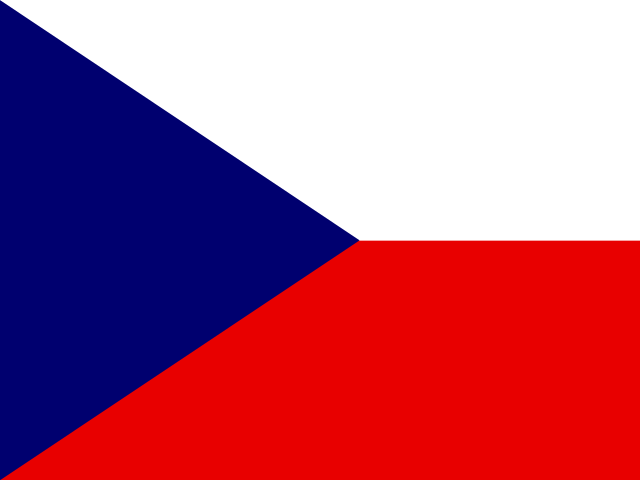
Czech is a Slavic language spoken by more than 10 million people, primarily in the Czech Republic. It is a fascinating language with a rich history and culture.
One interesting aspect of the Czech language is its unique phonology. Czech has a number of unique sounds that are not found in other Slavic languages, such as the ř sound, which is pronounced with a rolling of the tongue. Additionally, the language has a complex system of vowel length, which can change the meaning of a word. For example, the word "pán" means "lord," while "paan" means "a type of bread."
Czech is also known for its complex grammar system. It has seven cases, three genders, and two numbers. This can make it challenging for non-native speakers to learn, but it also allows for a great deal of nuance and precision in communication.
The Czech language has a rich literary tradition, with notable writers including Franz Kafka, Milan Kundera, and Bohumil Hrabal. It also has a strong music tradition, with composers such as Antonín Dvořák and Bedřich Smetana.
In recent years, the popularity of the Czech language has been on the rise, with more and more people around the world taking an interest in learning it. This is due in part to the growing number of opportunities to study abroad in the Czech Republic and the increasing importance of the country's economy in Europe.
Whether you're interested in the unique sounds of Czech or its rich cultural heritage, there are many reasons to explore this fascinating language. With its complex grammar and rich literary tradition, Czech is a language that rewards those who take the time to learn it.

English is a fascinating and versatile language that has become the global standard for communication. It is spoken by over 1.5 billion people worldwide, making it one of the most widely spoken languages in the world.
One of the most interesting things about English is its evolution over time. The language has been shaped by many influences, including Old English, which was spoken by Germanic tribes in England during the early medieval period. Over time, it developed into Middle English, before finally becoming Modern English as we know it today.
Today, English is an international language that is used in many countries around the world. It is the official language of many countries, including the United States, Canada, Australia, and the United Kingdom. Additionally, English is used widely in business, science, and technology, making it an essential tool for communication across borders.
Despite its widespread use, English has many different dialects and variations. Some of the most widely spoken dialects include American English, British English, and Australian English. Despite these differences, all varieties of English share a standard written form known as Standard English.
English has a rich literary tradition, with notable works of poetry and prose written by famous English writers such as William Shakespeare, Jane Austen, and Emily Bronte. Additionally, the language has had a significant impact on popular culture, influencing music, movies, and television shows produced primarily in English.
Learning English can be a challenging but rewarding experience. English grammar rules can be complex, and mastering pronunciation can be difficult. However, with practice and dedication, anyone can become fluent in the language and enjoy all the benefits it has to offer.
Lastly, English has become an essential tool for those interested in exploring global culture and engaging in international business and diplomacy. Mastery of the language can open up many opportunities for personal and professional growth, allowing individuals to connect with people from all over the world and gain a deeper understanding of diverse cultures.
In conclusion, English is an endlessly fascinating and useful language that deserves to be studied and appreciated. Its rich history, diverse dialects, literary tradition, and global importance make it an endlessly interesting language to learn and master. Learning English is a valuable skill that can open up many opportunities for personal and professional growth, as well as provide a gateway to understanding the diverse cultural traditions of English-speaking countries around the world.
| S nástupem noci přichází tma. | With the onset of night comes darkness. |
| Návštěvník nechal sestře vzkaz. | The visitor left a message for his sister. |
| Život je čím dál tím složitější. | Life is getting more and more complicated. |
| Vaše články se mi líbí. | I like your articles. |
| Ženy chtějí taky šukat. | Women want to fuck too. |
| Je naše země bohatá? | Is our country rich? |
| Moře bylo plné lodí. | The sea was full of boats. |
| Za prvé, štěstí souvisí s penězi. | First, happiness is related to money. |
| Kdo hodně cestuje, neprospívá. | Who travels a lot, does not make good. |
| Líbí se vám váš nový domov? | Do you like your new home? |
| Zvládnu to, když mi dáš šanci. | I can do it if you give me a chance. |
| Přiletěl včera z Tokia. | He arrived yesterday from Tokyo. |
| Máte tři kočky. | You have three cats. |
| Phoenix je hlavním městem Arizony. | Phoenix is the capital of Arizona. |
| Malé děti se bojí být samy ve tmě. | Young children are afraid to be alone in the dark. |
| Zpívala docela dobře. | She sang quite well. |
| Dnes má dobrou náladu. | She is in a good mood today. |
| Opřel se o zeď. | He leaned against the wall. |
| Dostáváte sem často dopisy? | Do you often get letters here? |
| Řekové také často jedí ryby. | Greeks also often eat fish. |
| Kolik obyvatel má Japonsko? | What is the population of Japan? |
| Právě jsem dokončil svou práci. | I just finished my work. |
| Má dobrý rukopis. | She has good handwriting. |
| Jeho manželka porodila dvojčata. | His wife gave birth to twin boys. |
| Zimní slunce hřeje jen trochu. | The winter sun is only a little warm. |
| Musíte dodržovat pravidla. | You must follow the rules. |
| Chci se naučit plavat. | I want to learn how to swim. |
| Zítra jí musím říct pravdu. | I have to tell her the truth tomorrow. |
| Na nebi bylo nespočet hvězd. | There were countless stars in the sky. |
| Muži by neměli nosit ofinu. | Men should not wear bangs. |