Experience fast and accurate Bulgarian-English translation with ArabicLib, your trusted online translation platform. Our tool supports more than 100 languages and thousands of language pairs, making it ideal for users worldwide who need efficient, reliable translations.
Bulgarian and English belong to two distinct branches of the Indo-European language family; Bulgarian is a South Slavic language, while English is a West Germanic language. Despite both using the European alphabetic system (though Bulgarian uses Cyrillic and English uses Latin letters), there are notable differences and a few similarities:
On our platform, users have access to a powerful Bulgarian-English dictionary containing hundreds of thousands of translations, including words, phrases, comprehensive definitions, synonym lists, accurate pronunciation guides, and numerous example sentences to support better understanding and practical usage.
Enhance your language skills with our simple yet effective flashcard tests. Users can practice and test their vocabulary in both directions and for any language pair supported, making ArabicLib ideal for beginners and advanced learners alike.
ArabicLib offers a well-organized phrasebook and vocabulary section, featuring essential and commonly used words and expressions for various real-life scenarios, designed to aid travelers, students, and anyone wishing to build a strong linguistic foundation in Bulgarian, English, and other languages.
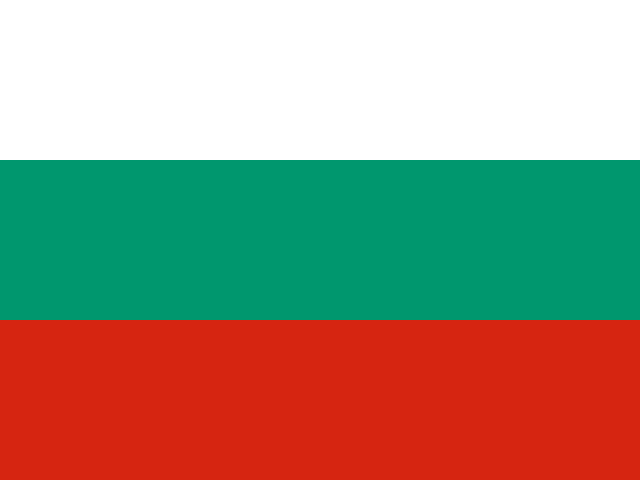
Bulgarian is a fascinating and unique language that is spoken by over 10 million people around the world. It is the official language of Bulgaria, and it has a rich and complex history.
One of the most interesting things about Bulgarian is its alphabet. The Bulgarian alphabet has 30 letters, which makes it one of the largest alphabets in the world. It is also unique in that it includes two additional letters, ѝ and ю, that are not found in any other Slavic language.
Bulgarian is also known for its rich literary tradition. Bulgarian literature dates back over a thousand years, and it has produced some of the most celebrated writers in the world, including Ivan Vazov, Hristo Botev, and Elisaveta Bagryana. Bulgarian literature reflects the cultural, social, and political history of the region, and it has played a significant role in shaping Bulgarian identity.
Another interesting aspect of Bulgarian is its role in the Balkan region. Bulgarian shares many similarities with other Slavic languages, but it also has distinct influences from Turkish and Greek. This unique blend of influences has contributed to the rich cultural heritage of the region.
Learning Bulgarian can be a rewarding and enriching experience. It can open up opportunities for travel, work, and personal growth, and it can provide a deeper understanding of the culture and history of the Bulgarian people. Whether you are interested in literature, music, or simply want to challenge yourself with a new language, studying Bulgarian can be a fascinating and fulfilling journey.
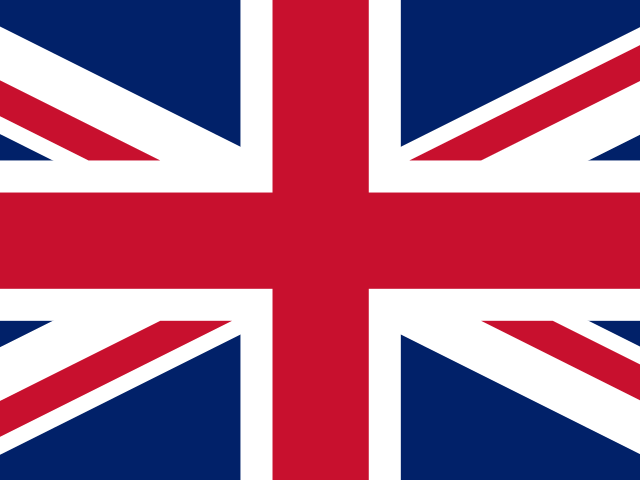
English is a language that has come to dominate the world in many ways. With over 1.5 billion speakers worldwide, it is the most widely spoken language on the planet. English is considered the international language of business, science, technology, and entertainment. It is also the official language of many countries, making it an essential tool for anyone interested in communicating with people from different cultures.
One of the most fascinating things about English is its history. The language has evolved over time, starting as a Germanic language spoken by Anglo-Saxon tribes in England. Over the years, it has been influenced by many other languages, including Latin, French, and Greek. This has resulted in a unique mix of words and phrases that make English such a rich and expressive language.
Another interesting aspect of English is its versatility. English can be used in a variety of contexts, whether it be for academic writing, business communication, or casual conversation. Its adaptability has made English the lingua franca of the modern world, allowing people from different cultures to communicate with ease.
Despite its widespread use, learning English can be challenging due to its complex grammar rules and pronunciation. Additionally, idioms and slang can make learning English difficult for non-native speakers. However, with dedication and practice, anyone can master the language and enjoy all the benefits it has to offer.
Perhaps one of the most interesting things about English is the way it has continued to evolve and change over time. From the Old English of the Anglo-Saxon period to the Modern English of today, the language has gone through many transformations. New words and phrases are constantly being added to the language, reflecting changes in society and technology.
Lastly, English has become the language of culture and entertainment. Many books, movies, and songs are written in English, making it an important tool for those interested in exploring literature or popular media.
In conclusion, English is a fascinating and versatile language that has come to dominate the world in many ways. It has a rich history and continues to evolve and change over time, making it an exciting language to study and master. Its widespread use has made it an essential tool for communication across cultures and its continued popularity guarantees its place as a language of great significance for years to come.
| Вятърът събори това дърво. | The wind toppled this tree. |
| Тя решава проблема. | She solves the problem. |
| Боря се за справедливост. | I fight for justice. |
| Напомни ми за теб. | It reminded me of you. |
| Това обяснение звучи убедително. | This explanation sounds convincing. |
| Никога няма да се върна. | I will never return. |
| Какво го доведе там? | What brought him there? |
| Следвай моето бяло перо! | Follow my white plume! |
| Мислите ли, че това е игра? | Do you think this is a game? |
| Доколкото знам, не е мързелив. | As far as I know, he is not lazy. |
| Все още има добри хора по света. | There are still good people in the world. |
| Как успявате да се съсредоточите? | How do you manage to focus? |
| Тя започна да плаче. | She began to cry. |
| Той се поддаде на изкушението. | He gave in to temptation. |
| Веднага изпратете спасители! | Send rescuers immediately! |
| Някога тук е имало стар храм. | There used to be an old temple here. |
| Винаги имайте речник под ръка. | Always have a dictionary handy. |
| Мълчанието му я ядоса. | It was his silence that angered her. |
| Сбърках я със сестра й. | I mistook her for her sister. |
| Поканихте ли някого на вечеря? | Did you invite anyone to dinner? |
| Знаете добре как стана. | You know well how it happened. |
| Не мога да умра тук. | I cannot die here. |
| Отнема много усилия. | It takes a lot of effort. |
| Вашата роля тук е толкова важна. | Your role here is so important. |
| Том е господар на думата си. | Tom is master of his word. |
| Това е, което ми трябва. | This is what I need. |
| Имам много стара марка. | I have a very old brand. |
| Той се засмя на шегата ми. | He laughed at my joke. |
| Защо винаги съм последен? | Why am I always last? |
| Почти никой не й вярва. | Almost no one believes her. |