ArabicLib offers a powerful and intuitive English-Spanish online translator designed for seamless translation in both directions. Whether you need to translate a simple sentence, a complex text, or HTML content itself, our tool provides fast and accurate results. With support for over 100 languages and thousands of translation pairs, ArabicLib is your one-stop solution for all your translation needs.
English and Spanish, despite both being widely spoken worldwide, belong to different language families: English is a Germanic language, while Spanish is a Romance language. Still, both have influenced each other over centuries due to history, commerce, and migration. Below are key similarities and differences that every translator should know:
When translating between English and Spanish, special attention should be paid to gender agreement, verb tense and mood, and idiomatic expressions that might not translate directly. False friends (words that look similar but differ in meaning) are also common and require caution.
On top of fast and accurate translations, ArabicLib provides an advanced English-Spanish dictionary with hundreds of thousands of entries, comprehensive definitions, pronunciation audio, synonym lists, and sentence examples. Strengthen your vocabulary and grammar with interactive tests and flashcards or practice real-life conversations and essential lexis using our phrasebook and thematic vocabulary sections. With ArabicLib, mastering English and Spanish becomes engaging, practical, and effective.

English is a fascinating language with a rich history and a wide variety of uses. With over 1.5 billion speakers around the world, it is one of the most widely spoken languages in the world. English is an incredibly versatile language, capable of expressing complex thoughts and ideas with its vast vocabulary and extensive grammar rules.
One of the unique features of English is its ability to absorb words from other languages, resulting in a language that is constantly evolving and changing. This has made English a truly global language, used by people all over the world for communication, business, and entertainment.
English is also the language of many of the world's great works of literature, including the plays of William Shakespeare, the novels of Jane Austen, and the poetry of William Wordsworth. English literature has had a profound impact on the world, shaping the way we think about ourselves and our place in the world.
In addition to literature, English is also the language of science and technology, with many of the world's most important scientific discoveries and innovations being made by English speakers. English is the language of the internet and social media, connecting people from all corners of the globe and allowing them to share their ideas and experiences.
Whether you're interested in business, travel, literature, science, or simply connecting with people from around the world, English is an essential language to learn. Its versatility and global reach make it a truly indispensable language, and its rich history and cultural significance make it an endlessly fascinating subject to explore.
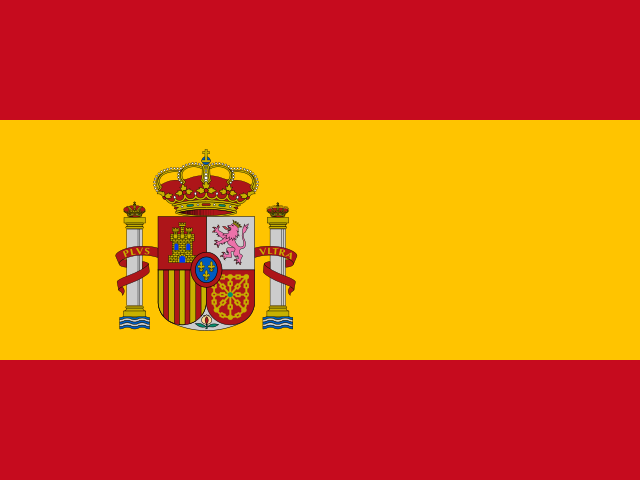
Spanish is a fascinating language that is spoken by over 500 million people worldwide. It is an official language in 21 countries, making it one of the most widely spoken languages in the world.
One of the most interesting things about Spanish is its rich history and cultural significance. The language has been shaped by many influences over time, including Latin, Arabic, and indigenous languages from the Americas. Additionally, it has a significant impact on Spanish culture, with many traditional songs, poetry, and literature written in Spanish.
Today, Spanish is an important language for business, science, and technology in Spain and around the world. Additionally, it is an essential tool for those interested in exploring Spanish culture and engaging in international business and diplomacy.
Despite its significance in Spain, Spanish has many different dialects and variations, with each region having its own unique version of the language. Some of the most widely spoken dialects include Castilian Spanish, Mexican Spanish, and Argentinian Spanish.
Learning Spanish can be a challenging but rewarding experience. Spanish grammar rules can be complex, and mastering pronunciation can be difficult. However, with practice and dedication, anyone can become fluent in the language and enjoy all the benefits it has to offer.
Lastly, Spanish has become an essential tool for those interested in exploring Spanish culture and engaging in international business and diplomacy. Mastery of the language can open up many opportunities for personal and professional growth, allowing individuals to connect with people from all over Spain and gain a deeper understanding of diverse cultures.
In conclusion, Spanish is a fascinating and useful language that deserves to be studied and appreciated. Its rich history, cultural significance, and global importance make it an endlessly interesting language to learn and master. Learning Spanish is a valuable skill that can open up many opportunities for personal and professional growth, as well as provide a gateway to understanding the diverse cultural traditions of Spain and other Spanish-speaking regions.
| Please do it immediately. | Por favor, hazlo de inmediato. |
| You should not deceive the poor. | No debes engañar a los pobres. |
| He did everything he could. | Hizo todo lo que pudo. |
| She had no objection. | Ella no tuvo ninguna objeción. |
| Tom helps his wife. | Tom ayuda a su esposa. |
| I feel the love of loved ones. | Siento el amor de los seres queridos. |
| Take as much as you want. | Toma todo lo que quieras. |
| Beware of pickpockets. | Cuidado con los carteristas. |
| Tom is not a match for Mary. | Tom no es rival para Mary. |
| They sang with pleasure. | Cantaron con placer. |
| Dolphins are very smart animals. | Los delfines son animales muy inteligentes. |
| I will let you leave. | Dejaré que te vayas. |
| Do you still need my help? | ¿Aún necesitas mi ayuda? |
| You arrived three days ago. | Llegaste hace tres días. |
| Depends on the context. | Depende del contexto. |
| Optimism is a lack of information. | El optimismo es la falta de información. |
| You must do your duty. | Debes cumplir con tu deber. |
| Progress is hateful to them. | El progreso les es odioso. |
| Italy is in Europe. | Italia está en Europa. |
| Our dad drives to work. | Nuestro papá conduce al trabajo. |
| He cut his left hand with a knife. | Se cortó la mano izquierda con un cuchillo. |
| I bought two pairs of trousers. | Compré dos pares de pantalones. |
| Have you landed yet? | ¿Ya aterrizaste? |
| He made her happy. | Él la hizo feliz. |
| Can you cook fish? | ¿Sabes cocinar pescado? |
| He came to in the hospital. | Llegó al hospital. |
| Do you know how to cook meat? | ¿Sabes cocinar carne? |
| Everything happened so fast. | Todo sucedió tan rápido. |
| Tom befriends Mary. | Tom se hace amigo de María. |
| The butcher grinded the meat. | El carnicero trituró la carne. |